
A recent Henderson Loggie survey of Scottish law firms found that over 60% aren’t yet using AI-based tools, but many expect to trial or adopt them soon. Cloud platforms, hybrid working setups, and digital document management have already become standard. The technology is arriving. What hasn’t kept pace is the governance around it: the policies, oversight structures, and accountability that determine whether all this technology is being used safely.
For firms operating across Edinburgh, Aberdeen, and Glasgow, the combination of regulatory pressure, rising cyber threats, and growing client expectations means governance has moved from back-office housekeeping to a front-of-house concern.
What Technology Governance Means for a Law Firm
Technology governance is the framework that determines how your firm selects, deploys, manages, and retires the technology it relies on. It covers who has access to what, how data is classified, what policies exist for AI tools, how vendors are vetted, and how technology decisions are made and reviewed. It’s the bridge between your IT systems and your professional obligations.
For law firms in Scotland, the stakes are higher than most. The SRA expects firms to have effective systems protecting client data and money. Both the Law Society of Scotland’s Guide to Generative AI and the Law Society of England and Wales have made clear that existing professional duties apply regardless of what technology is used. The tool may be new, but the responsibility isn’t.
How Governance Supports Compliance and Client Confidentiality
The SRA’s 2025/26 business plan centres on rising misconduct investigations, client money protection, and keeping pace with the risks that come with technology adoption in legal services, with investigations up 40% year-on-year. The Law Society of Scotland has made AI a key project for 2026. And in February 2026, the SRA delivered a webinar on AI regulation, reinforcing that explainability, data protection, and ethical use are baseline expectations.
These warnings are not theoretical. In 2025, DPP Law Ltd was fined £60,000 by the ICO after attackers accessed 32 gigabytes of sensitive case files. That same year, the Legal Aid Agency suffered a breach exposing personal data dating back over a decade. NetDocuments’ analysis of ICO data found that breaches at UK legal firms compromised data relating to 4.2 million people – roughly 6% of the UK population.
A structured governance framework tackles this directly: keeping access controls aligned with current roles, classifying data so AI tools can’t expose privileged material, and ensuring vendor contracts include proper data handling obligations.
Governance Gaps Common in UK Legal Practices
Having worked with law firms across Scotland and the wider UK, we see certain patterns repeat. They’re rarely negligent. More often, they come from growth, good intentions, and not enough time.
No formal AI usage policy
Fee-earners are using generative AI to draft correspondence or research case law, sometimes through free platforms with no data retention safeguards. The Law Society of Scotland’s AI guide explicitly warns that platforms like ChatGPT may use inputs as training data by default. Yet many firms have no written policy governing which tools can be used, by whom, or for what.
Overshared permissions in Microsoft 365
Initial permissions are often set broadly, then drift as people change roles. When AI tools like Microsoft Copilot sit on top of this environment, they inherit those same permissions, surfacing information that individuals were never meant to see.
Vendor relationships without security oversight
NetDocuments’ ICO analysis found that more than half of data breaches at UK legal firms were caused by insiders, with human error responsible for 39% of incidents. If supplier relationships don’t include clear security expectations, they become a blind spot.
No documented technology roadmap
Many firms make technology decisions reactively, such as replacing hardware when it fails or adopting software when a partner recommends it. Without a plan linking investments to business goals, spending fragments and strategic gaps go unaddressed.
Steps to Build a Governance Roadmap
Audit your current environment
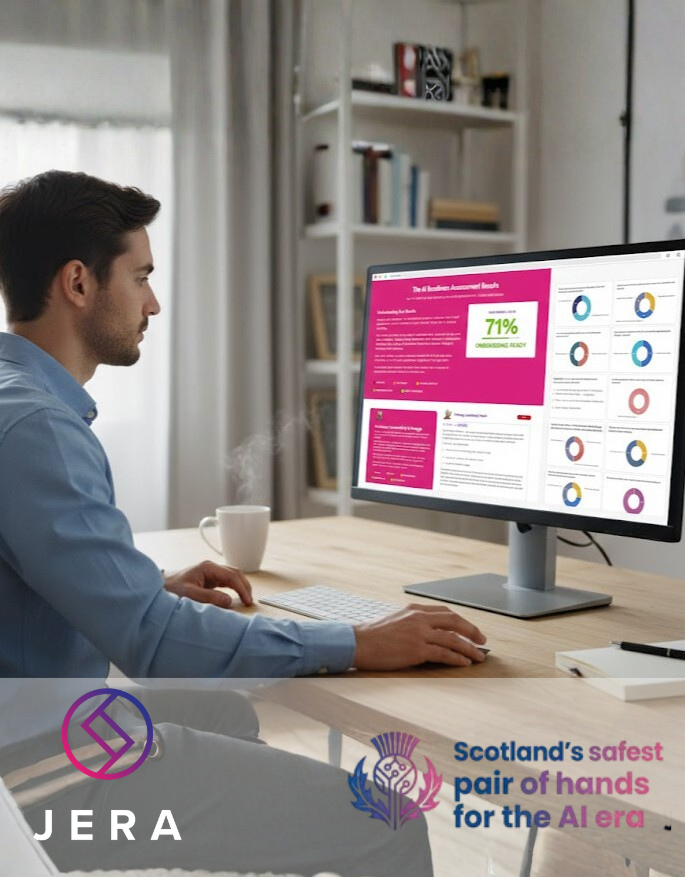
Map your systems, review who has access to what, and identify where sensitive information lives. For Microsoft 365 users, check sensitivity labels, data classification, and whether permissions match current roles. That is why we developed our Legal AI Readiness Assessment, giving firms clarity before committing to new tools.
Create clear, practical policies
It doesn’t need to be 40 pages. It needs to be clear enough that every staff member knows what’s expected. The Law Society of Scotland recommends covering which AI tools may be used, the requirement for human oversight, and consequences for non-compliance.
Assign ownership
Technology decisions happen across IT, compliance, operations, and practice groups. Without clear accountability, gaps open between them.
Review regularly
Quarterly reviews, even brief ones, keep governance connected to what’s happening in the business.
Good Governance Creates Value Beyond Risk Reduction
When governance is in place, audit readiness improves because documentation already exists. AI adoption becomes less fraught because boundaries have been drawn before tools are deployed. Staff gain clarity on what is permitted and what is not.
There’s a commercial angle too. The NCSC’s Cyber Threat Report notes that nearly three-quarters of the UK’s top 100 law firms have been affected by cyber attacks. Clients are asking sharper questions about data handling, AI governance, and vendor management. Firms that can answer with documented evidence will win work that those without it won’t, particularly when pursuing contracts with larger organisations or regulated industries where supply chain security is a formal evaluation criterion.
If your firm has gaps, that’s normal. At Jera, we work with law firms across Scotland to understand their current position and put the right controls in place. If you would like an objective view of where your governance stands, contact us for a confidential conversation.