
The “Great AI Gold Rush” is officially in full swing. Since Microsoft integrated Copilot Chat into nearly every M365 Business and Enterprise license, the barrier to entry for Artificial Intelligence has effectively vanished. Your employees already have the “button.” They are likely already clicking it.
But here is the hard truth that most organizations are discovering the expensive way: AI is a multiplier. If you apply it to a robust, well-defined business process, it multiplies your efficiency. If you apply it to a disorganized, vague, or siloed environment, it simply multiplies your chaos at a much faster rate.
This is why the first pillar of our AI Readiness Assessment isn’t about servers, code, or encryption. It’s about Business, Strategy, and People. If you want to move beyond “playing with chatbots” and start building a digital workforce, you have to start here.
Moving Beyond “AI Magic Thinking”
Many leadership teams suffer from what we call “AI Magic Thinking.” That’s the belief that if you buy enough licenses and give them to enough people, the business will magically become more profitable.
In reality, AI adoption is a change management project disguised as a software update. To be successful, the business must move through a specific journey. We look at three critical areas in this first pillar to determine if you are building on rock or sand.
1. The M365 Baseline: The Digital Mirror
Before an AI can help you, it has to know who you are and what you do. In the Microsoft ecosystem, that knowledge lives in the “Graph”—the underlying map of your emails, files, and chats.
During the assessment, we ask: To what extent are your working files stored in SharePoint, Teams, and OneDrive compared to local storage?
If your team is still saving critical project data to their local C: drive or an old on-premise file server, your AI is effectively “blind.” It cannot summarize a meeting it wasn’t invited to, and it cannot draft a proposal based on data it can’t reach. Pillar 1 forces a “digital cleanup” that ensures your most valuable business assets are visible to the tools you’re paying for.
2. ROI & Intent: The 6R Test
We don’t want you to deploy AI just because it’s trendy. We want you to deploy it because it solves a bottleneck. This is where we apply the 6R Test to your current workflows. We look for processes that are:
Repeatable: Does this happen every Monday morning?
Rule-based: Is there a clear logic to how it’s done?
Resource-heavy: Is it eating up 10 hours of a senior manager’s week?
Risk-prone: Does a human typo here cost the company money?
Revenue-linked: Does speeding this up directly impact the bottom line?
Role-based: Can this task be handled by a “Digital Employee”?
By identifying 3–5 high-impact use cases during the assessment, we move AI from a “cool toy” to a “strategic asset” with a measurable Return on Investment within the first 60 to 90 days.
3. Culture & Leadership: The Fear Factor
Technology is easy; people are hard. The biggest blocker to AI today isn’t technical—it’s psychological. If your staff believes that AI is a “replacement tool” designed to downsize their department, they will not adopt it. In fact, they may consciously or unconsciously sabotage it.
Pillar 1 assesses Leadership Alignment. Is the C-Suite speaking with one voice? Are they framing AI as an augmentation tool—a “Copilot” that handles the grunt work so the humans can do the creative, high-value work? Without an executive sponsor and a clear cultural roadmap, your AI initiative will die in the middle management layer.
The 7-Step Journey to an AI-Driven Business
To give our clients a clear destination, we map their current status against the 7-Step AI Journey. This prevents the “overwhelm” of trying to do everything at once.
Copilot: Getting the basics right—productivity and trust.
AI App: Creating your first dedicated utility (e.g., an internal HR Bot).
Action Agent: Moving from “talking” to “doing” (e.g., an AI that can process a refund).
Agentic Workflow: Automating a whole process from end to end.
Multi-Agent System: Coordinating “teams” of AI agents.
Digital Workforce: AI roles with KPIs and structured oversight.
AI-Driven Business: AI is embedded into your entire operating model.
Most organizations are currently at Step 0. The Goal of Pillar 1 is to get you safely to Step 1 and 2, with a clear sightline toward the “Agentic” future of Step 4.
Our Process: How the Assessment Works
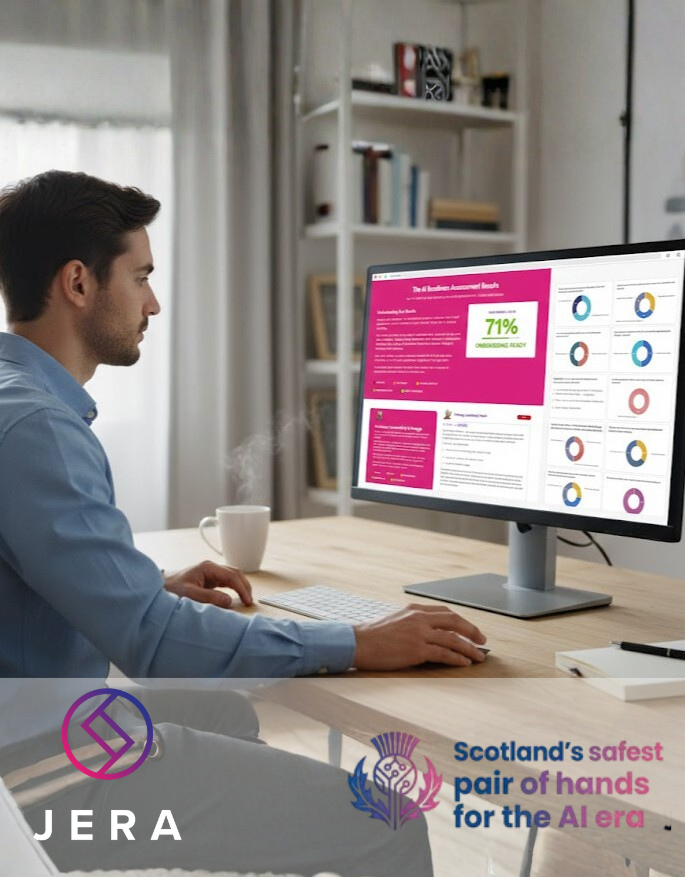
The Agentic AI Readiness Assessment is designed to be low-friction but high-impact. Here is how we evaluate your Business, Strategy, and People:
Discovery Session: We meet with your key stakeholders (Business Leads, HR, and IT) to audit your current “Why.” We uncover where “Shadow AI” is already happening and where the biggest frustrations lie.
Scoring & Gap Analysis: Using our proprietary framework, we score your readiness on a scale of 1 to 5.
A score of 1 means you have high risk (e.g., data is overshared, no leadership alignment).
A score of 5 means you are optimized and ready for autonomous agents.
The ROI Opportunity Map: We don’t just give you a report card; we give you a roadmap. We identify the “Quick Wins”—tasks you can automate right now to pay for the cost of the licenses.
The Remediation Plan: We provide a prioritized list of what needs to be fixed, why it matters, and who is responsible for fixing it.
The Verdict: Are You Ready?
The “Blast Radius” of AI has exploded. Because every employee now has access to these tools, the risk of data oversharing and strategic drift is a universal reality. You can no longer afford to “wait and see.”
If you want to ensure your organization isn’t just “using AI,” but is actually being transformed by it, you must start with the foundation. You must start with Pillar 1.
Ready to see where you stand? Don’t let your AI journey be an accident. Take control of your digital future by scheduling your AI Readiness Assessment today. We will help you close the gaps, secure your data, and build a roadmap that moves you from Copilot to a fully integrated Digital Workforce.